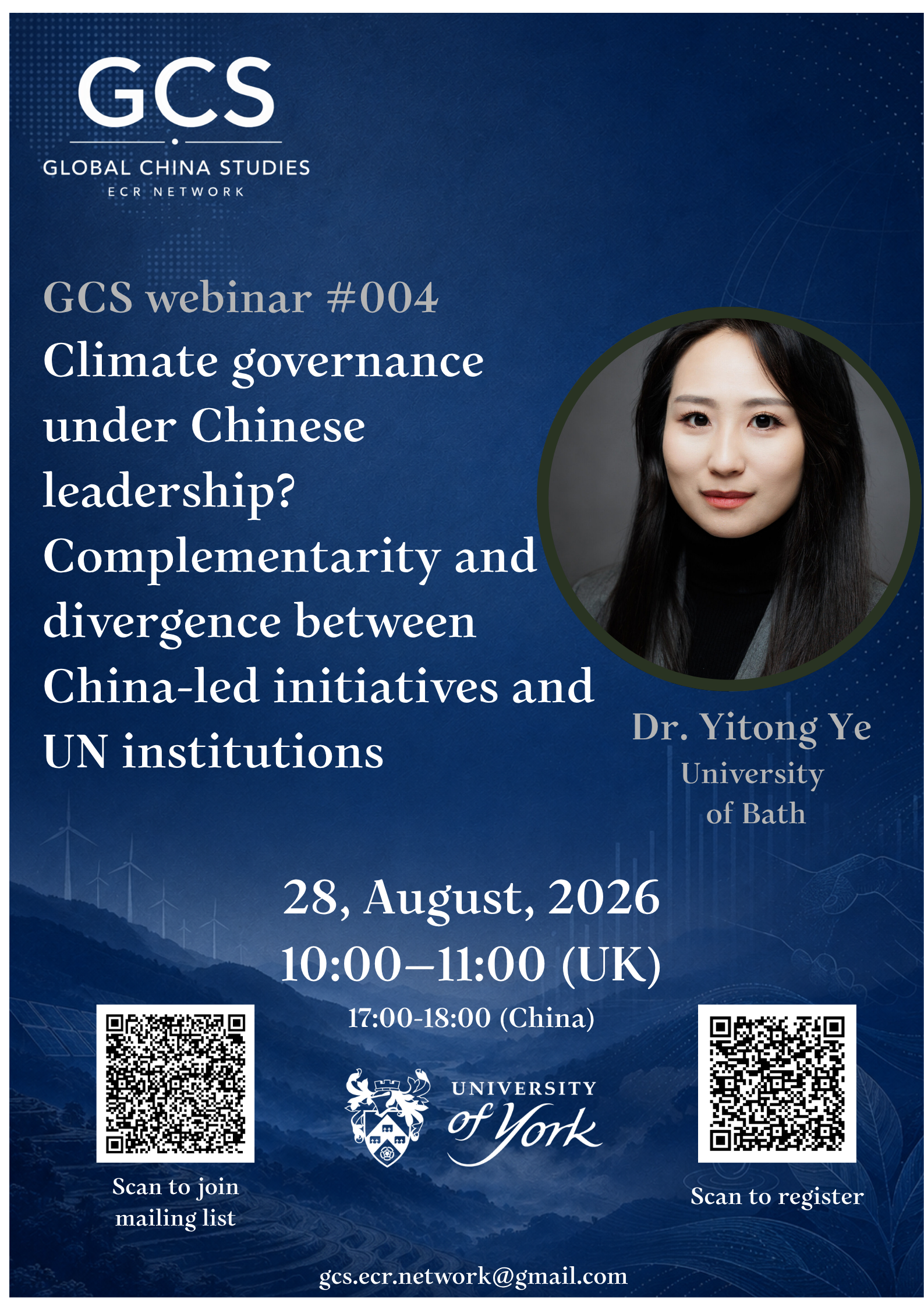
GCS webinar #004 Climate Governance under Chinese Leadership? Complementarity and Divergence Between China-led Initiatives and UN institutions

Dr.Yitong Ye, Postdoctoral Research Associate at the University of Bath, will present her paper: "Climate governance under Chinese leadership? Complementarity and divergence between China-led initiatives and UN institutions".
ABSTRACT
While global climate governance has become increasingly complex and polycentric, extant scholarship has primarily focused on multilateral and transnational initiatives led by Global North actors. With a recent geopolitical shift marked by the US' withdrawal from climate action and China's dominance in clean energy technologies, it is imperative to assess how China influences global climate governance through its own international initiatives. Drawing on China's Global Environmental Leadership (CGEL) Database, we identify an emerging China-centered governance ecosystem consisting of 59 international cooperation initiatives led by various Chinese actors in different multilateral and transnational arenas. We then use social network analysis and Large Language Model-assisted text analysis to assess these Chinese initiatives' alignments with existing international norms and institutions. Our analysis shows that China-led international climate initiatives have closely aligned with internationally agreed principles and UN institutions not only discursively, but also through direct institutional engagements. At the same time, Chinese initiatives tend to emphasize synergies between climate action and sustainable development – a seemingly distinctive approach to climate governance, which is likely shaped by China's developing country identity and its own development trajectory. This is exemplified by the case of the Global Energy Interconnection Development and Cooperation Organization, which illustrates how Chinese initiatives can simultaneously align with UN institutions and norms while also promoting its own development visions. Our findings offer new insight into how China is reshaping global climate governance — not by challenging the existing multilateral order, but by embedding itself within it while advancing its own development priorities.